
GTO poker explained
What is GTO in poker?
GTO stands for Game Theory Optimal. In poker, it describes an equilibrium strategy: when every player uses an optimal strategy, no player can improve their result simply by changing their own strategy.
That does not mean a GTO player wins every hand, never has a losing session or always chooses one obvious action. Poker contains hidden information and variance. In many situations, a balanced strategy mixes between actions—betting a hand sometimes and checking it at other times.
A simple way to understand GTO
Think about rock–paper–scissors. If you always choose rock, an observant opponent can exploit you by always choosing paper. Choosing each option unpredictably removes that simple weakness. Poker is vastly more complicated, but the central idea is similar: a balanced strategy does not give an opponent an easy pattern to attack.
What does a poker solver do?
A poker solver models a precisely defined situation. We give it assumptions such as the players’ ranges, stack depth, pot size and permitted bet sizes. It compares strategies repeatedly until neither player can gain meaningfully by changing strategy alone.
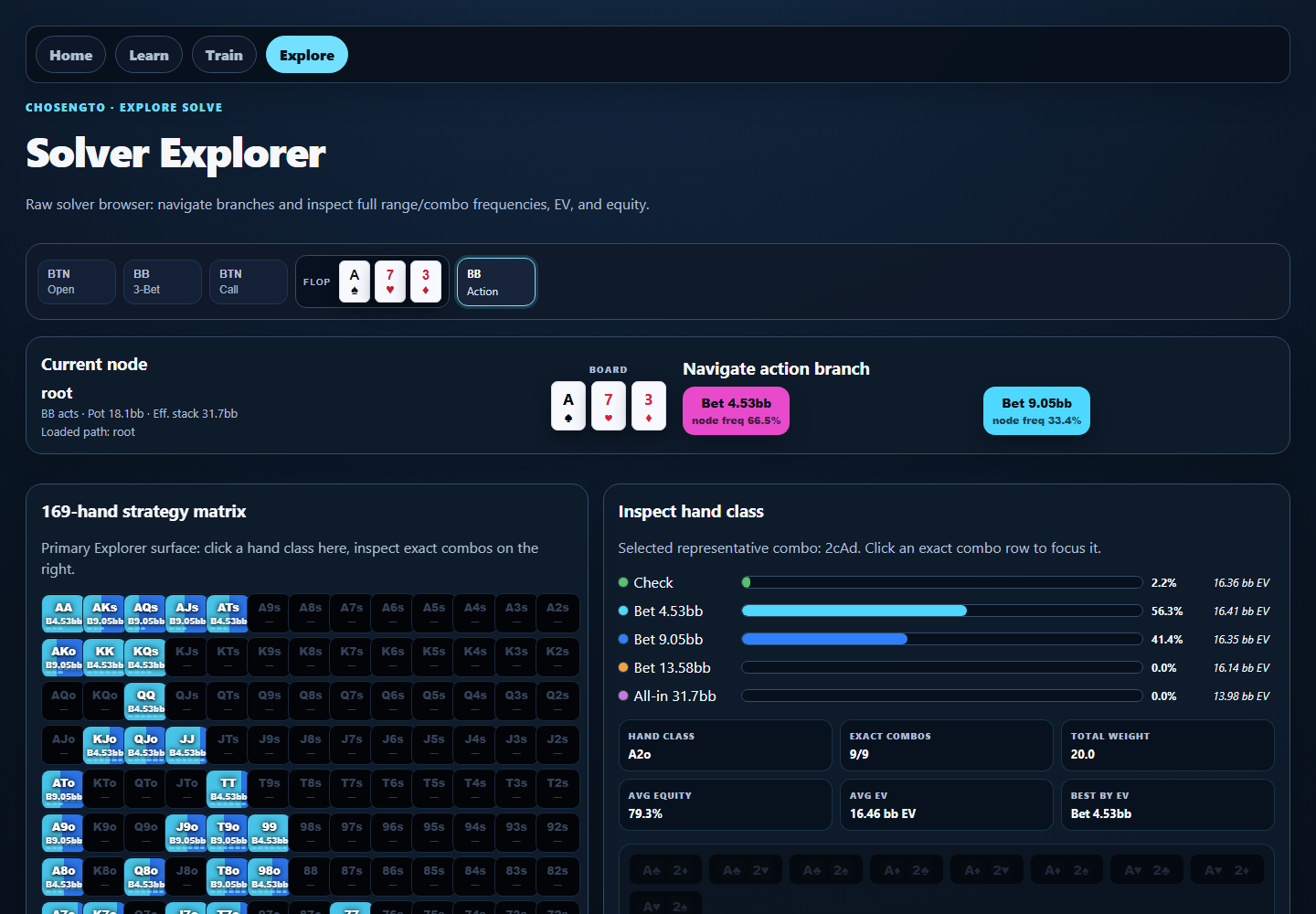
The output may show which hands bet, check, call, raise or fold; how frequently each action is used; and the expected value (EV) of the choices. It is not a universal answer for every poker game. Change the assumptions and the solution can change.
Why is GTO difficult to study?
A solver can produce thousands of precise answers. Memorizing one frequency on one flop does not explain what to do on another board, against another position or at another stack depth. Useful study asks why the strategy changes:
- Which player has the stronger overall range?
- Who has more of the strongest possible hands?
- How does the board interact with each player’s range?
- Which hands gain value from betting, checking or denying equity?
- What changes when the position, stack depth or bet size changes?
GTO and exploitative poker are not opposites
GTO gives us a coherent baseline. If an opponent folds too often, calls too widely or uses an unbalanced range, we may deliberately move away from that baseline to exploit the mistake. Understanding the baseline helps us identify the deviation and adjust for a reason—not merely guess.
How PokerChosen approaches GTO study
Chosen GTO is being designed around Learn, Train and Explore. Learn builds the concepts and explains why strategies change. Train lets you practise decisions and receive feedback on your choices. Explore gives you access to the underlying solver data so you can investigate strategies in depth.
The goal is not to turn poker into a list of answers to memorize. It is to help you recognize patterns, understand the assumptions behind solver output and build knowledge you can carry from one situation to the next.
If ranges, equity, expected value or pot odds are still new, begin with the free Learn Hold’em course. Those foundations make GTO study far more useful.